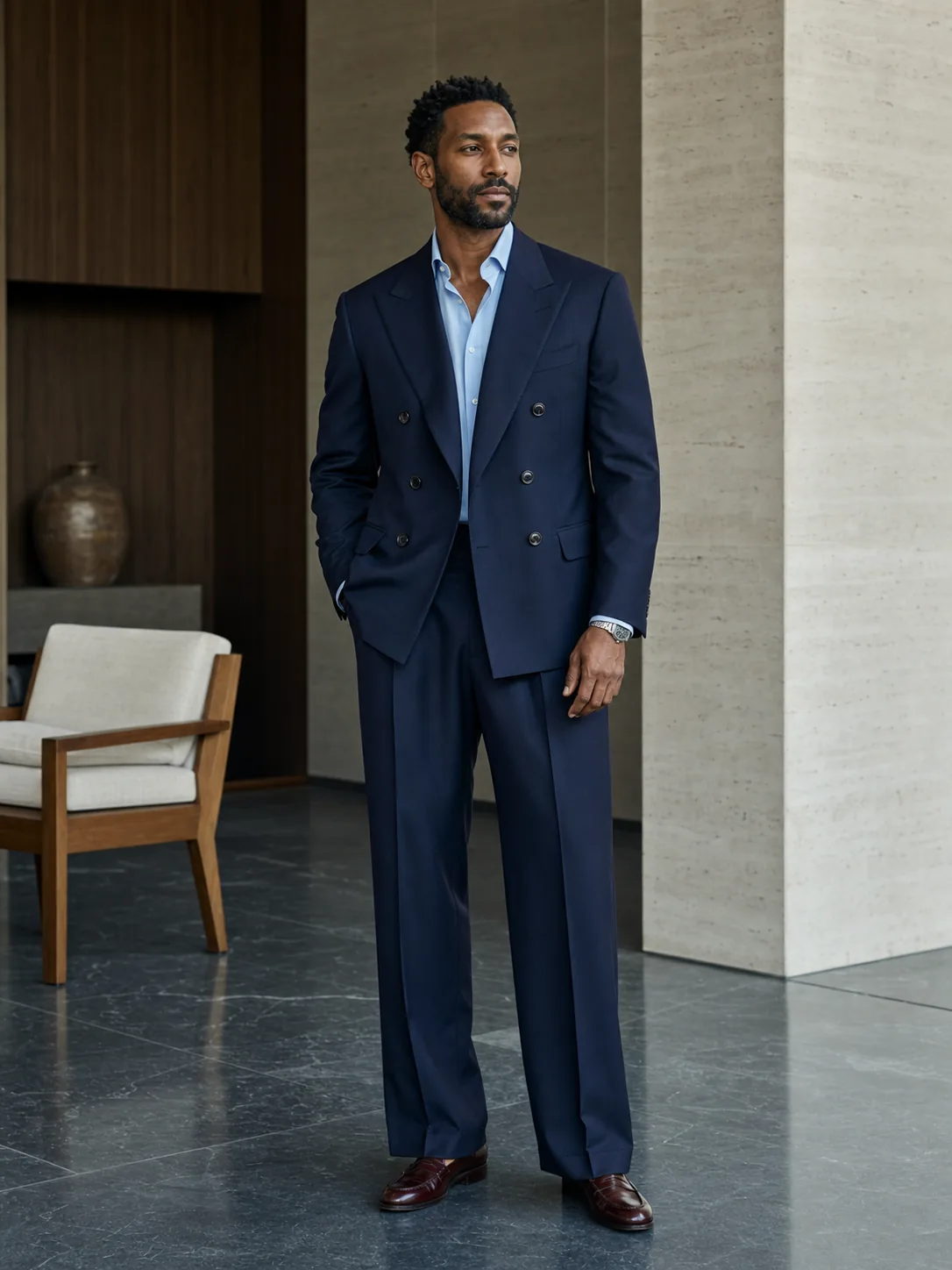
People form impressions from clothing rapidly, often without realising how much status, gender, age, and workplace stereotypes shape the judgement. Understanding that process can help you communicate intentionally—but it should also make employers and institutions more cautious about treating appearance as evidence of ability.
Status cues can be mistaken for competence
Oh, Shafir, and Todorov showed the same faces with clothing associated with higher or lower economic status. Observers more often judged a face as competent when the clothing signalled greater wealth, even after very brief exposure.
The result does not show that expensive clothing makes anyone more capable. It demonstrates a bias in perception. For a wearer, neat and context-aware clothing may reduce accidental distraction; for an evaluator, the study is a warning to separate presentation from evidence of skill.
Small tailoring changes can alter ratings
Howlett and colleagues compared first impressions of one man wearing two subtly different suits. Minor differences in fit changed some ratings. Because the design used one model and formal menswear, it cannot define good fit for every body, gender, culture, or role.
The practical lesson is mechanical rather than moral: check shoulder placement, closures, hem balance, and movement. A garment that stays in place lets you give attention to the interaction instead of constant adjustment.
Context beats a universal dress code
A law office, design studio, restaurant, construction site, and remote interview communicate through different norms. Dressing appropriately means understanding safety and expectations while preserving enough familiarity to move and speak naturally.
No outfit can guarantee trust or respect, and biased standards should be challenged rather than silently obeyed. Treat clothing as one controllable communication cue—not a measure of worth.
THREE THINGS TO REMEMBER
- Observers may confuse economic status cues with competence.
- Fit can affect perception, but evidence from one suit study cannot become a universal rule.
- Appearance is a communication cue, not proof of character or ability.
Questions and answers
How fast do clothing-based impressions form?
They can form within a very brief exposure. Speed does not make the judgement accurate; it can make bias harder to notice.
Do expensive clothes make a better impression?
Status-associated clothing can bias some observers, but price is not competence. Clean condition, context, and comfort are more responsible priorities.
Should I change my personal style to be taken seriously?
Not automatically. Identify genuine safety or context requirements, then choose a version that still feels recognisable and comfortable to you.
Sources and references
- DongWon Oh, Eldar Shafir, Alexander Todorov (2020). Economic status cues from clothes affect perceived competence from faces. Nature Human Behaviour. DOI: 10.1038/s41562-019-0782-4
Limitation: Nine experiments measured observers' biased competence judgements, not the photographed people's actual ability or performance.
- Neil Howlett, Karen Pine, Ismail Orakcioglu, Ben Fletcher (2013). The influence of clothing on first impressions: Rapid and positive responses to minor changes in male attire. Journal of Fashion Marketing and Management. DOI: 10.1108/13612021311305128
Limitation: The study used one male model and two versions of formal attire, so its findings should not be treated as a universal dress code.