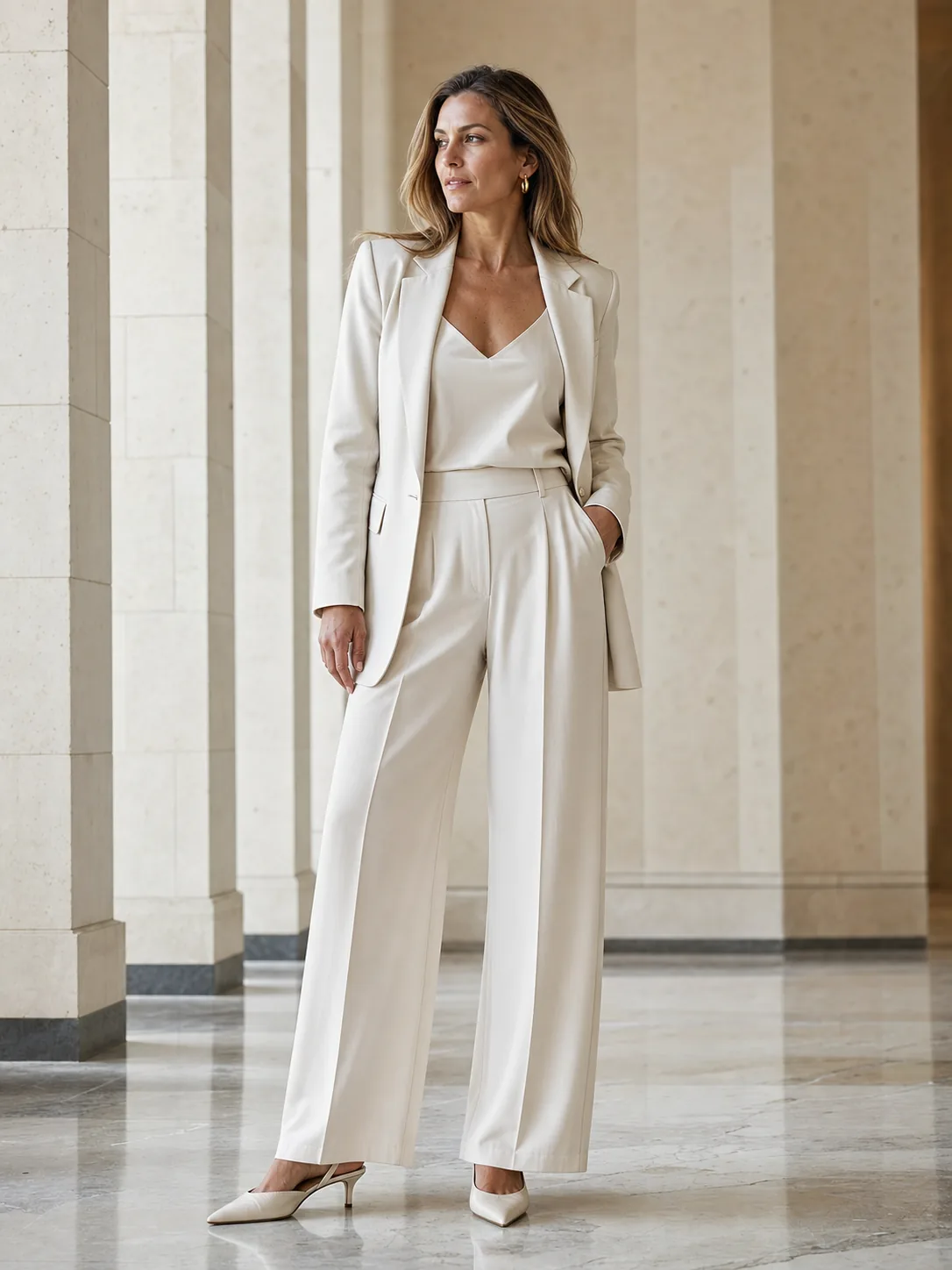
Body-shape systems can offer vocabulary, but they often turn into lists of corrections: hide this, create that, never wear the other. A more useful approach asks whether a garment stays where its construction intends, permits the required movement, and supports the visual effect the wearer actually wants.
Fit is an experience, not a number
Sizing varies across brands and garments, so the label is logistics rather than a judgement. Check shoulders, chest, waist, hips, rise, sleeve, and hem separately. A larger or smaller tagged size can be the correct tool for a particular pattern.
Research has linked satisfaction with apparel fit and body evaluation, but correlation cannot tell us which causes which. Fitting rooms combine physical sensation with cultural pressure, mirrors, sizing systems, and prior experiences.
Use movement and construction checks
Find the garment's least adjustable construction point. A jacket often needs to work at the shoulder; trousers need space through the rise and hip. Other areas may be easier for a tailor to change. Then sit, reach, walk, bend, and use the actual pockets.
Wrinkles are information, not a moral verdict. Strong horizontal pulling, closures that separate, or seams displaced from their intended line may indicate insufficient room. Excess fabric that collapses or rotates can indicate a different pattern is needed.
- Where must the garment stay stable, and where do you need ease?
- Does the fabric return to position after movement?
- Can you wear it with the shoes, layers, and underwear you actually use?
- Do you like the silhouette when standing and moving?
What virtual try-on cannot measure
A virtual try-on can compare colour, broad proportion, and level of formality. It does not know the complete measurements, stretch recovery, seam tension, opacity, thermal comfort, or motion of a real product.
Never use an AI image to judge your body or select a size with confidence. Verify the retailer's measurements, fibre content, construction photos, reviews, and return policy, then physically try the item when possible.
THREE THINGS TO REMEMBER
- The garment must serve the person; the body does not owe a size chart conformity.
- Assess construction, movement, and comfort in specific areas.
- AI can preview an idea but cannot guarantee physical fit or size.
Questions and answers
Are body-shape categories scientific fit systems?
No. They are simplified styling categories that omit construction, movement, preference, disability, and variation within each label.
How can I tell whether clothing is too small?
Look for restricted movement, displaced seams, separating closures, and strong tension lines. A fabric touching the body is not by itself evidence of the wrong size.
Can virtual try-on choose my size?
Lace Riot cannot. It creates a synthetic visual preview and does not measure your body or the real garment.
Sources and references
- Karen L. LaBat, Marilyn R. DeLong (1990). Body Cathexis and Satisfaction with Fit of Apparel. Clothing and Textiles Research Journal. DOI: 10.1177/0887302X9000800206
Limitation: The study reported associations between fit satisfaction and body evaluation; its correlational design cannot establish direction of causation.
- Sarah Grogan, Simeon Gill, Kathryn Brownbridge, Sarah Kilgariff, Amanda Whalley (2013). Dress fit and body image: A thematic analysis of women's accounts during and after trying on dresses. Body Image. DOI: 10.1016/j.bodyim.2013.03.003
Limitation: The qualitative sample of 20 women provides detailed context but is not designed to estimate how common each experience is in a population.
- Md. Jakir Hossain, Hyo Jung (Julie) Chang, Robert Paul Jones (2025). I bought it and I feel good! An examination of fit factors and self-evaluation related to confident clothing decisions and psychological well-being. Journal of Retailing and Consumer Services. DOI: 10.1016/j.jretconser.2024.104167
Limitation: Relationships among fit, decision confidence, self-evaluation, and wellbeing do not prove that buying clothes causes better mental health.