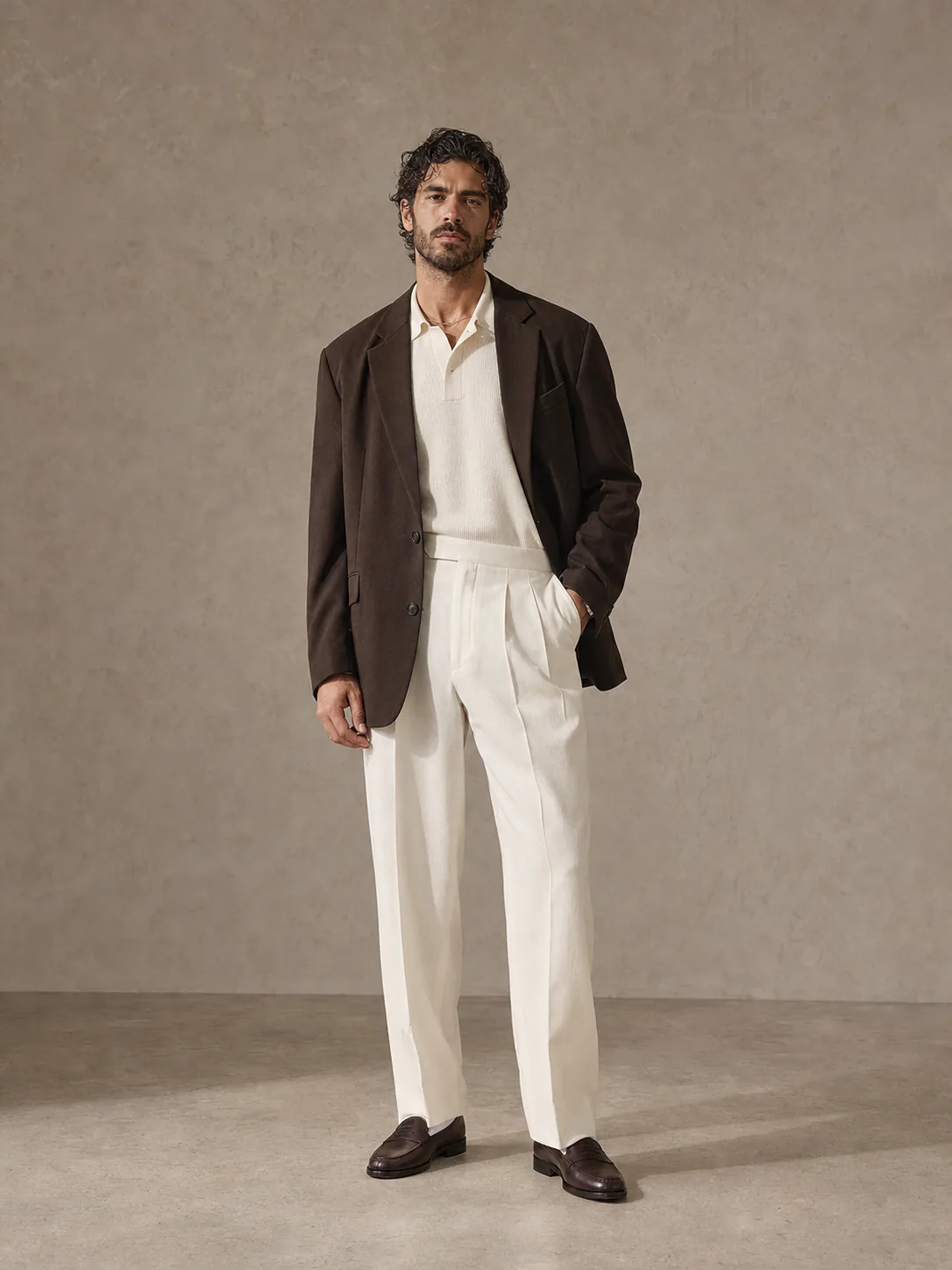
The appealing version of clothing psychology says that the right jacket will make you sharper, more confident, and more successful. The evidence is more interesting and less magical. Clothing can cue roles, expectations, and self-perception in particular settings, yet effects vary with meaning, task, method, and the person wearing it.
What enclothed cognition is meant to describe
Enclothed cognition is the proposal that wearing an item can matter partly because of the symbolic meaning attached to it. A blazer may signal authority to one person, constraint to another, and familiar workwear to a third. The same fabric therefore need not produce the same response.
A useful interpretation is that clothing forms part of the context around a task. It can support a ritual for beginning work or stepping into a role. It cannot replace preparation, sleep, knowledge, practice, or psychological care.
Formal clothing and abstract processing
Slepian and colleagues linked formal clothing with more abstract processing in a series of studies. Some analyses suggested that a subjective sense of power might help explain the association. The work concerns a style of processing in specific tasks, not a rise in intelligence.
Abstract thinking is not always preferable. Strategy can benefit from distance, while proofreading, sewing, and safety checks require attention to detail. The useful question is not whether a garment makes you smarter, but whether your clothing supports the task and feels credible to you.
Why replication changes the story
A preregistered direct replication did not reproduce the well-known lab-coat effect in a Stroop task. A later meta-analytic assessment reported weaknesses in the early literature alongside evidence in some newer studies. Together, these results argue against a universal clothing hack.
Try a personal, low-stakes test instead. Wear a familiar outfit for a recurring task, record comfort and focus, and compare several days. Treat the result as a practical observation, not proof that clothing alone caused the difference.
- Remove physical distractions such as pinching, overheating, or constant adjustment.
- Choose clothing whose meaning feels authentic rather than imposed.
- Judge a pattern across days, not one unusually good meeting.
THREE THINGS TO REMEMBER
- Clothing can work through meaning and context, not through a garment's name alone.
- Formal clothing does not increase intelligence, and some famous findings did not replicate.
- Use clothing as a supportive cue, never as a promise of psychological change.
Questions and answers
Does dressing formally make you more intelligent?
No. Some studies connect formal clothing with a particular processing style in specific tasks. That is not an increase in intelligence or a guaranteed performance benefit.
Has enclothed cognition been disproved?
A simple yes-or-no verdict would be misleading. Important findings have failed to replicate, while broader reviews find support for some context-dependent effects.
What should I wear when I need to focus?
Start with comfort and low distraction. Then choose a familiar outfit that you associate with the task and observe your own results over several sessions.
Sources and references
- Michael L. Slepian, Simon N. Ferber, Joshua M. Gold, Abraham M. Rutchick (2015). The Cognitive Consequences of Formal Clothing. Social Psychological and Personality Science. DOI: 10.1177/1948550615579462
Limitation: The studies examined particular abstract-processing tasks. Formal clothing did not increase intelligence, and some analyses were correlational.
- C. Blaine Horton Jr., Hajo Adam, Adam D. Galinsky (2025). Evaluating the Evidence for Enclothed Cognition: Z-Curve and Meta-Analyses. Personality and Social Psychology Bulletin. DOI: 10.1177/01461672231182478
Limitation: The review found problems in parts of the early literature alongside evidential value in newer work. Effects remain heterogeneous and context-dependent.
- Devin M. Burns, Elizabeth L. Fox, Michael Greenstein, Gayla R. Olbricht, DeMaris Montgomery (2019). An Old Task in New Clothes: A Preregistered Direct Replication Attempt of Enclothed Cognition Effects on Stroop Performance. Journal of Experimental Social Psychology. DOI: 10.1016/j.jesp.2018.10.001
Limitation: This preregistered study did not reproduce the original lab-coat effect in its Stroop task, limiting strong universal claims.