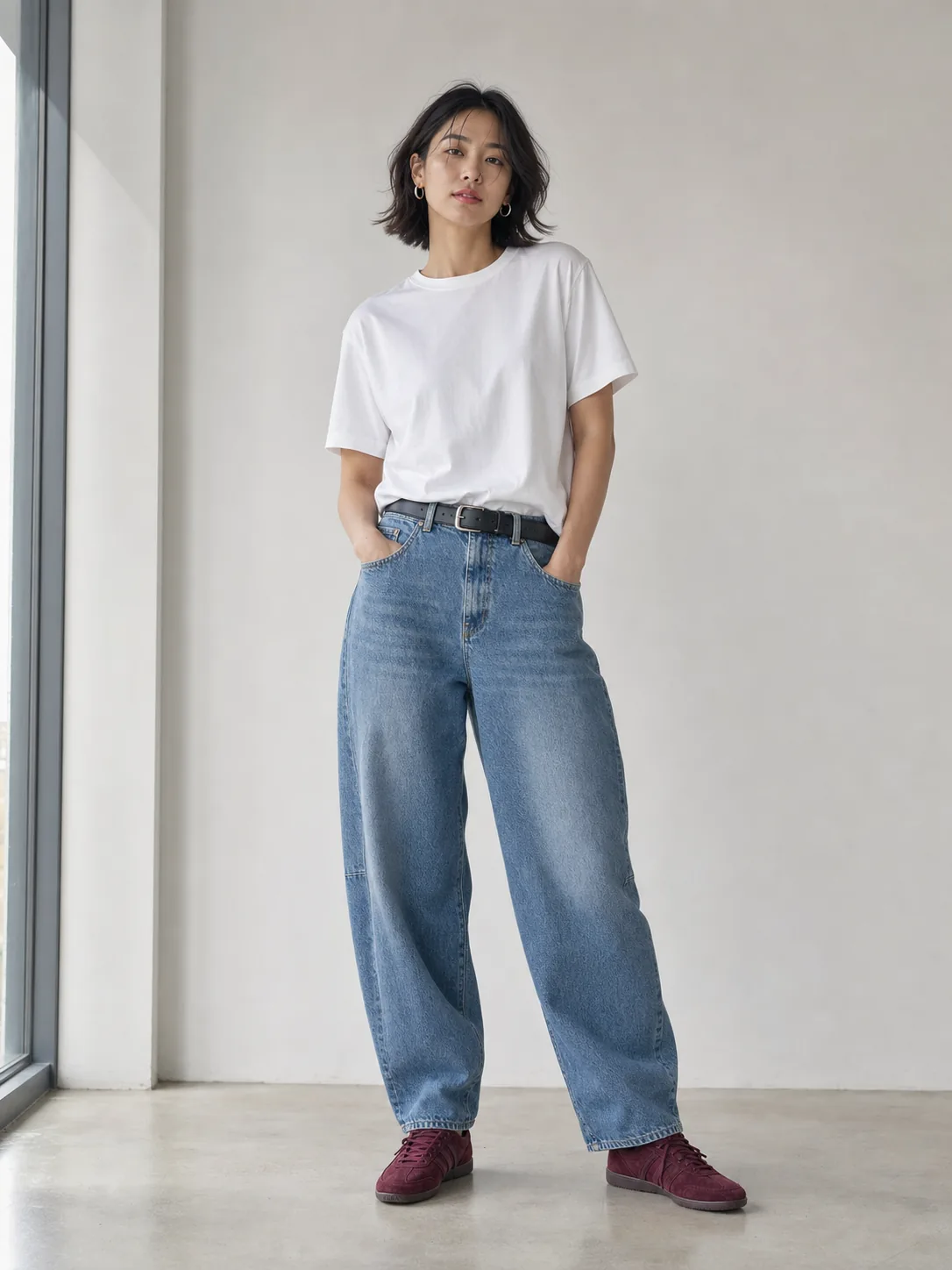
The internet often sells capsule wardrobes as a perfect list. A useful capsule starts elsewhere: the activities you repeat, the clothes you already reach for, weather, laundry frequency, sensory needs, and the number of outfits required between washes.
Audit wear, not aspiration
For two to four weeks, record what you wear and why. Note weather, setting, comfort, laundry, and items that force a change. This reveals whether the missing link is a warm layer, practical footwear, a work bottom, or simply a repair.
Wardrobe-utilisation research focuses on the share of clothing actually used. That makes a better target than owning a fashionable number of pieces. An item that fits your life and repeats across formulas is more valuable than a photogenic orphan.
Build outfit formulas before a shopping list
Write three to five reliable formulas, such as wide trousers plus knit plus structured layer, or dark denim plus substantial tee plus weatherproof jacket. List the items that can swap within each position.
Test every proposed purchase against at least three complete outfits using clothes you own. The rule is not scientific, but it prevents a new item from creating a chain of additional purchases.
- Cover your most frequent activities first.
- Include outerwear, footwear, and laundry constraints.
- Allow accent colours and occasion pieces if you genuinely use them.
- Review after a season rather than pursuing instant perfection.
Longer wear matters only when it replaces consumption
Life-cycle research indicates that extending wear can reduce impact when those extra wears displace production and purchase. Keeping an unused garment in storage for years is not the same as wearing it repeatedly.
Repair, tailoring, care, and resale can support use, but avoid turning sustainability into individual guilt. Product durability, labour, energy systems, and business models also matter. A capsule is one practical tool, not a complete environmental solution.
THREE THINGS TO REMEMBER
- Start with a wear diary and real activities.
- Design repeatable outfit formulas before buying individual pieces.
- Keeping fewer items helps only when they are used and reduce replacement demand.
Questions and answers
How many pieces should a capsule wardrobe have?
There is no evidence-based universal number. Climate, work, laundry access, disability, caregiving, and social life all change the requirement.
Must a capsule wardrobe use neutral colours?
No. Connection matters more than beige. A repeated bright colour or print can work if it combines with several pieces you use.
Should I discard everything outside the capsule?
No. Start by observing and rearranging. Sell, donate, or recycle only through responsible routes when you are confident an item no longer serves you.
Sources and references
- Stephen G. Wiedemann, Simon J. Clarke, Quan V. Nguyen, Zhong Xiang Cheah, Aaron T. Simmons (2023). Strategies to reduce environmental impacts from textiles: Extending clothing wear life compared to fibre displacement assessed using consequential LCA. Resources, Conservation and Recycling. DOI: 10.1016/j.resconrec.2023.107119
Limitation: The life-cycle model depends on additional wear actually displacing new production; keeping unused clothes for longer does not deliver the same benefit.
- Ho Jung Choo, So Yun Sim, Ha Kyung Lee, Ha Bin Kim (2014). The effect of consumers' involvement and innovativeness on the utilization of fashion wardrobe. International Journal of Consumer Studies. DOI: 10.1111/ijcs.12078
Limitation: The study of 211 women operationalised wardrobe utilisation as the share of clothing actually worn; population and self-report limits apply.